The short answer
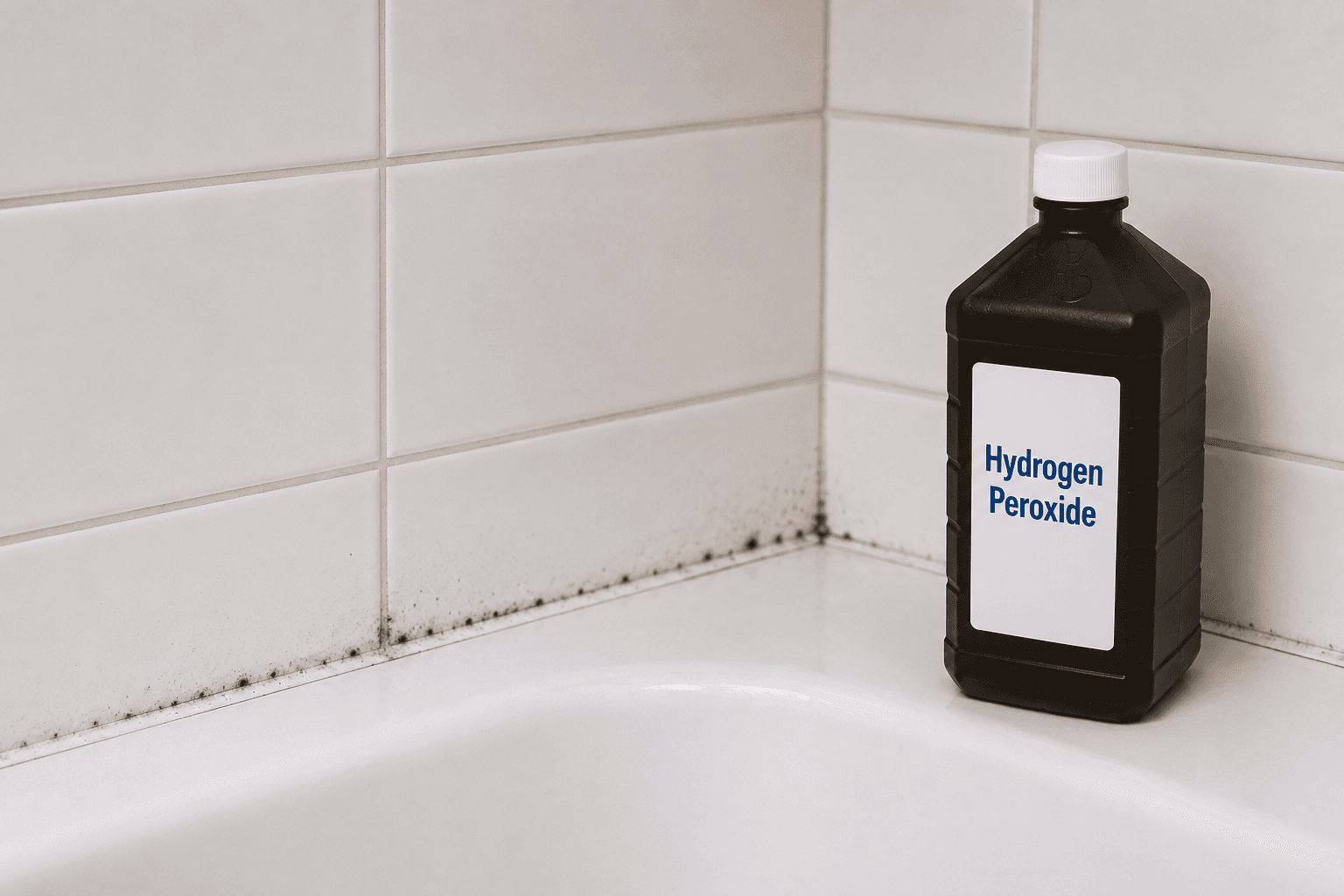
Yes. 3% hydrogen peroxide (the kind in the brown bottle in your bathroom cabinet) kills most household mold species, and unlike vinegar or bleach, it penetrates porous surfaces to a useful depth. For grout, sealed wood, fabric, and the back side of bathroom fixtures, it's often the right tool. For tile and glass, vinegar or bleach is overkill but fine. For drywall mold, no liquid agent reaches the colony in the gypsum core; you're cleaning the symptom and ignoring the problem.
The most underrated thing about hydrogen peroxide: it breaks down into water and oxygen. There's nothing to rinse off, no toxic residue, no fumes worse than what you'd encounter at a doctor's office.
The most overrated thing about hydrogen peroxide: it will bleach the color out of fabric, dyed grout, and some finishes. Always test an inconspicuous spot first.
Why hydrogen peroxide works
Hydrogen peroxide (H₂O₂) is an oxidizer. When it contacts mold cell walls, it strips electrons from the proteins and lipids holding the cells together. The result: rapid cell death. The chemistry is similar to bleach, but with no chlorine ions and no toxic byproducts. The leftover after the reaction is just water and oxygen.
The 3% concentration in drugstore peroxide is the right strength for household mold. Higher concentrations (12% "food grade," 35% industrial) exist but offer no real benefit for surface mold and substantially increase the risk of skin burns and respiratory irritation. Stick with the brown bottle from the pharmacy.
The thing that makes peroxide different from vinegar and bleach for our purposes: it penetrates. Acetic acid in vinegar sits on the surface. Chlorine in bleach evaporates within minutes. Hydrogen peroxide soaks in, reacts with mold inside the material, then breaks down into harmless components. For grout and sealed wood, that depth matters.
Where hydrogen peroxide works best
These are the situations where peroxide is the right tool, often better than bleach or vinegar:
- Grout lines and tile joints: peroxide gets into the porous cement where bleach can't.
- Sealed wood surfaces: cabinets, finished trim, treated wood. Test color first.
- Fabric and upholstery, in white or neutral colors: peroxide can lift surface mold from canvas, white linens, light-colored cushions. Will bleach colored fabric.
- Bathroom fixtures, including the back of the toilet and behind the sink trap.
- Plastic shower curtains, tile, and glass.
- Sealed concrete and masonry surfaces.
- Books and paper goods (gently; peroxide does mildly damage paper but less than the mold itself).
The penetration is what sets it apart. If the mold is rooted just below the surface, common in old grout, peroxide reaches it. Vinegar and bleach do not.
Where hydrogen peroxide doesn't help
- Untreated drywall. Peroxide penetrates a few millimeters but not enough to reach a colony rooted in the gypsum core. The drywall needs replacement.
- Insulation. Porous, contaminated, irreplaceable. Throw it out.
- Heavily affected unfinished wood with deep colonization. Surface treatment doesn't fix structural mold.
- Colored fabrics or dyed grout you care about. Peroxide will lighten or strip the color. Test first or use a different agent.
- Polished metal finishes. Repeated peroxide can corrode some metals over time; rinse promptly if used.
- Patches larger than a doormat. The EPA's 10-square-foot DIY threshold applies regardless of cleaning agent.
How to use hydrogen peroxide on mold
This is the protocol for the most common case: a small patch of mold on grout, sealed wood, or a tile fixture.
- Open a window or run a fan. Peroxide fumes are mild, but spore disturbance is the bigger concern.
- Wear gloves and eye protection. Peroxide is gentle on skin in 3% form but stings a paper cut, and you don't want it in your eyes.
- Test a hidden spot first if the surface is colored. Apply a drop, wait 10 minutes, blot. If you see lightening, use a different agent on that material.
- Spray or pour 3% hydrogen peroxide directly on the mold. Soak the area. A dark bottle is fine; peroxide doesn't need to be transferred to a fresh container.
- Let it sit for 10–15 minutes. Look for the characteristic bubbling; that's the oxidation reaction. Bubbling means it's working. No bubbling means the peroxide is old and degraded; get a new bottle.
- Scrub with a stiff brush or non-scratch sponge. Move away from clean areas.
- Wipe with a damp cloth, then dry completely. No rinse needed in the chemical sense (peroxide breaks down on its own), but you do need to remove any spore debris.
- Watch the spot for two weeks. Mold returning at the surface means colony is reaching deeper than you treated.
A note on the bottle: peroxide breaks down in light. That's why pharmacy bottles are opaque brown. An old, half-used bottle that's been sitting in a sunny bathroom for a year is probably half-strength. If it doesn't bubble visibly when it hits mold, buy a fresh bottle.
What people get wrong about hydrogen peroxide
"It works on everything." No. It bleaches color. It can degrade finishes over time with repeated use. It penetrates grout but not deep enough to fix structural mold.
"Higher concentration is more effective." 3% is the sweet spot for home use. 12% food-grade peroxide is sometimes recommended in online forums, but it offers minimal additional killing power and substantially more risk to skin, eyes, and lungs.
"Mix it with vinegar for a more powerful cleaner." Don't. Combining peroxide and acetic acid produces peracetic acid, which is an effective disinfectant in commercial settings but a known respiratory and skin irritant at home. The combination is not worth the risk.
"Mix it with bleach." Definitely don't. Hydrogen peroxide and bleach react rapidly, releasing oxygen gas and producing irritant byproducts. In concentration, the reaction is violent enough to cause spattering. Stick with one or the other.
"It's safe for skin, so I don't need gloves." Mostly, but 3% peroxide still stings broken skin and is uncomfortable in eyes. Gloves and goggles are cheap insurance.
Peroxide vs. vinegar vs. bleach: when each one wins
| Surface | Best agent | Why |
|---|---|---|
| Glazed tile / glass | Any of the three | All work; bleach is fastest, vinegar safest |
| Grout lines | Hydrogen peroxide | Only one that penetrates porous grout |
| Stainless steel / rubber | Vinegar | Less corrosive than bleach over time |
| Sealed wood | Hydrogen peroxide | Penetrates surface, less harsh than bleach |
| Unsealed drywall | None (replace it) | Liquid agents can't reach the root colony |
| White fabric | Hydrogen peroxide | Penetrates fiber; will bleach color |
| Colored fabric | None reliably | Mold-affected colored fabric usually has to be discarded |
| Painted walls | Bleach (if paint is in good shape) | Test first; will strip paint if formula is incompatible |
The full comparison and decision rule lives in how to get rid of mold.
When to skip the DIY route entirely
The EPA's threshold for DIY mold cleanup is 10 square feet of visible mold (roughly a 3×3 foot area). Above that, professional remediation is recommended regardless of which cleaning agent you'd otherwise reach for. The IICRC S520 standard, which is what reputable remediation companies follow, sets additional rules about containment and clearance testing.
Skip the peroxide and call a pro if:
- The patch is larger than a doormat.
- The mold is on drywall, untreated wood, insulation, or ceiling tiles.
- You can smell mold without seeing the source.
- The mold returned within a few weeks of a previous DIY cleaning.
- Anyone in the house has asthma, immune suppression, or a serious mold allergy.
- The mold is in or near HVAC vents.
- There's an active leak you haven't fixed.
For pros who follow the IICRC standard, request a free quote. Most respond within an hour.
Renting? Read this first
If you're a tenant:
- Peroxide on a small patch of grout or a tile shower wall is the kind of thing tenants typically handle.
- Larger patches, anything on drywall, and anything caused by a leak are generally the landlord's responsibility in most states.
- Document the mold before treating it. Photos with timestamps, written notes, an email to your landlord.
- State habitability laws vary. Many states require landlords to address mold caused by structural issues, but the rules differ. Check your local tenants' rights organization.
This article is general information, not legal advice.
Questions to ask if you're hiring a pro
Before signing anything, ask:
- Are you IICRC-certified for mold remediation (S520)?
- Will you find and address the moisture source as part of the job?
- How will you contain the work area to prevent spore migration?
- Will you provide post-remediation clearance testing by an independent lab?
- What's covered if the mold returns within a year?
- Can you give me a written scope of work and itemized estimate?
Frequently asked questions
Is 3% hydrogen peroxide strong enough to kill mold?
Yes. Studies on common indoor mold species (Aspergillus, Cladosporium, Penicillium) show 3% peroxide is effective on contact with 10–15 minutes of contact time. Higher concentrations don't reliably improve results and increase risk.
Hydrogen peroxide vs. vinegar: which is better?
It depends on the surface. Vinegar is better for stainless steel, rubber, and surfaces where you want zero color risk. Peroxide is better for grout, sealed wood, and white fabric because it penetrates porous materials.
Does hydrogen peroxide kill black mold?
On non-porous and lightly porous surfaces, yes; peroxide is effective against most strains of Stachybotrys chartarum. The bigger issue: most black mold in homes is on drywall, and no liquid agent reaches the colony in the gypsum core. If you suspect black mold on drywall, call a pro.
How long does hydrogen peroxide take to kill mold?
Leave it in contact with the moldy surface for 10–15 minutes before scrubbing. The visible bubbling tells you the oxidation reaction is happening; when bubbling stops, the reaction is done.
Does hydrogen peroxide stain or bleach?
On colored fabrics, dyed grout, and some finishes, yes. Always test an inconspicuous spot first. On white surfaces, neutral grout, and most tile, it's safe.
Do I need to rinse hydrogen peroxide off after using it?
Not chemically; it breaks down to water and oxygen on its own. But wipe the surface with a damp cloth and dry it to remove any spore debris.
Why isn't my hydrogen peroxide bubbling?
It's probably old. Peroxide degrades in light over time, especially if the bottle has been opened and sitting in a bright bathroom. If a fresh application doesn't visibly bubble when it contacts mold, buy a new bottle.
Related reading on MoldNation
- Does vinegar kill mold?
- Does bleach kill mold?
- How to get rid of mold: the honest DIY guide
- Does Lysol kill mold?
- Mold on walls: what to do
- What is mold remediation, and how do pros do it?
Sources for this article: published lab studies on hydrogen peroxide's antifungal activity against common indoor mold species (Aspergillus, Cladosporium, Penicillium), the EPA's "A Brief Guide to Mold, Moisture, and Your Home," and the IICRC S520 standard summary. This article is general information, not medical, legal, or remediation advice, for any mold problem larger than a 3×3 foot patch, or any involving health symptoms, consult a qualified professional. Last updated May 26, 2026.