The short answer
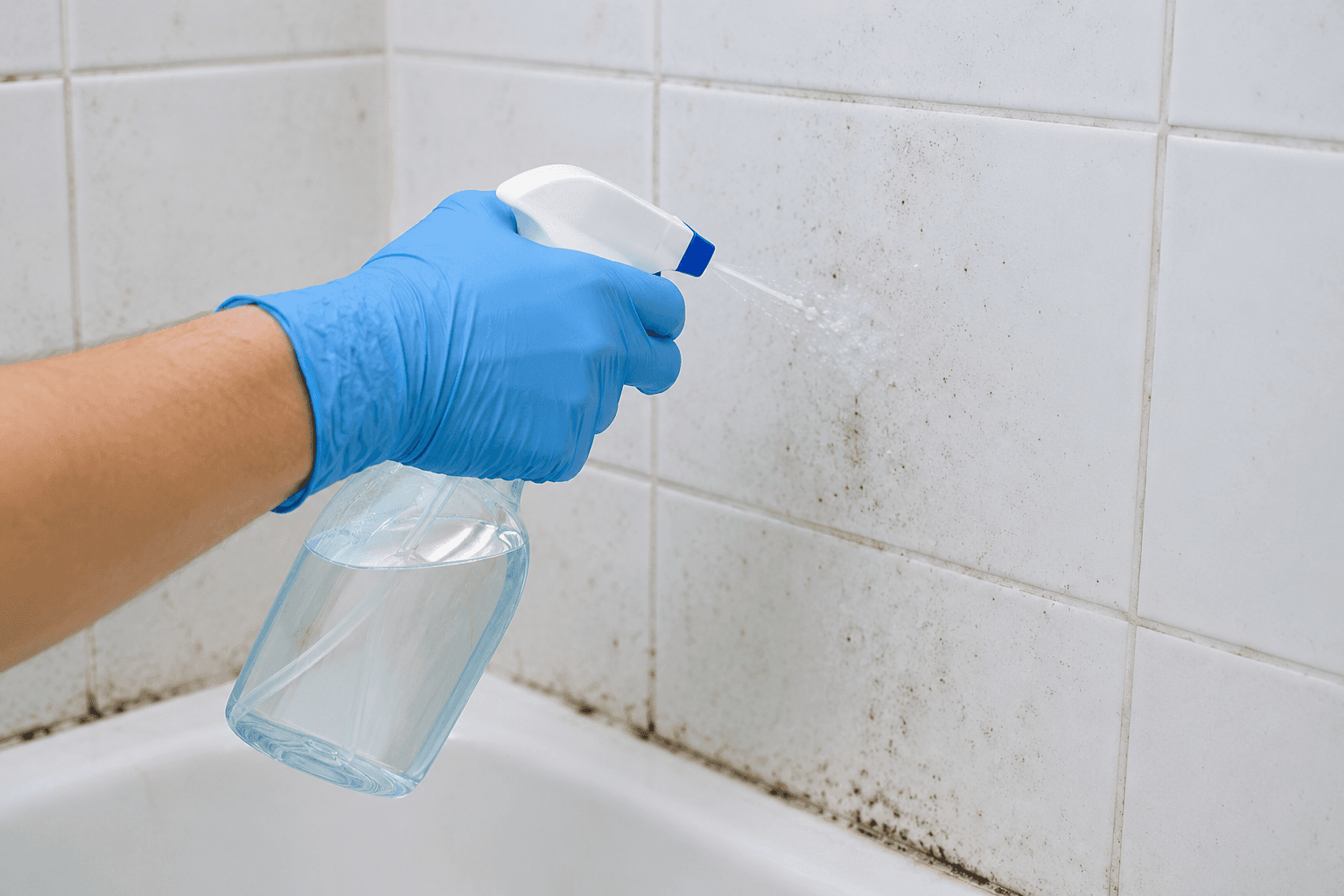
Yes, bleach kills mold, but only the part you can see, and only on surfaces that don't absorb water. On a tile shower wall or a glass shower door, bleach works fine. On drywall, untreated wood, grout, or anything porous, bleach kills the surface stain and leaves the root colony alive underneath. Two to four weeks later, the spot reappears, often darker than before.
That's why most modern mold remediation guidance, including the EPA's, no longer recommends bleach for porous building materials. If you've been pouring bleach on a drywall stain hoping it'll fix the problem, you've been doing it wrong, and the mold has been quietly winning.
Why bleach fails on porous surfaces
Chlorine bleach is sodium hypochlorite, usually 5–6% in the bottle, diluted to about 0.5% when you mix it 1:10 with water. The chlorine ion is what kills mold on contact. It's a powerful oxidizer that breaks down the proteins in mold cells.
The problem is the chlorine doesn't soak in. It evaporates off the surface within minutes. The water it was dissolved in, though, sinks into anything porous: drywall, wood, grout. So the chlorine bleaches the visible stain on top (you wipe the spot, it looks white again, you feel like you've won), and the water that just delivered the bleach is now down inside the material, where it actively encourages whatever mold colony is rooted there to keep growing.
This is the part most people miss. Bleach on porous surfaces isn't neutral. It can make the problem worse than doing nothing.
Where bleach actually works
These are the situations where bleach is the right tool:
- Glazed ceramic tile (the tile itself, not the grout between).
- Glass: shower doors, windows, mirrors.
- Sealed countertops: quartz, sealed granite, laminate, polished concrete.
- Stainless steel and metal fixtures: sink edges, faucets, drain covers.
- Plastic and rubber: shower curtains, the rubber gasket on a front-loading washing machine, plastic trash cans.
- The exterior of toilet bowls and tubs (the porcelain itself).
The pattern: hard, non-absorbent, easy to rinse. If a drop of water sits on top of the surface rather than soaking in, bleach is appropriate.
Where bleach fails (don't use it on these)
- Drywall and gypsum board. Porous. Bleach removes the visible color and feeds the colony underneath.
- Untreated or unfinished wood: studs, framing, wood floors, raw cabinetry.
- Grout lines. Despite looking solid, grout is porous cement. Bleach lightens the stain but doesn't penetrate. Repeated bleaching also erodes any sealer.
- Carpet, fabric, upholstery. Bleach destroys color and weakens fibers; mold in fabric needs replacement, not cleaning.
- Insulation, drywall paper, ceiling tiles, cardboard. Throw these out instead.
- Painted surfaces with chalking or peeling paint. The bleach goes through the failed paint into whatever's underneath.
If the patch you want to clean is on any of these, bleach is the wrong answer. Use hydrogen peroxide for grout, replace the affected drywall, or call a pro if the area exceeds the EPA's 10-square-foot DIY threshold.
How to use bleach correctly (when it's the right tool)
If you've confirmed the surface is non-porous and the area is small (under a doormat in size), here's the right protocol:
- Ventilate first. Open a window, run a fan. Bleach fumes are an irritant even in normal dilutions.
- Wear gloves, eye protection, and old clothes you don't mind ruining. Bleach will bleach.
- Mix 1 cup of bleach per 1 gallon of water in a spray bottle or bucket. This is the CDC's recommended dilution for surface mold cleanup. Stronger doesn't kill more; it just produces more fumes.
- Apply to the moldy surface. Soak it. Don't be stingy.
- Let it sit for 10–15 minutes. Contact time matters. Don't wipe immediately.
- Scrub with a non-metallic brush or sponge. Move spores away from clean areas, not into them.
- Rinse with clean water and dry completely. Any remaining moisture defeats the point; moisture is why the mold grew there.
- Watch the spot for two weeks. If it returns, you're not dealing with surface mold. There's a colony underneath, and bleach can't reach it.
A common mistake people make: using bleach straight from the bottle. Undiluted, it's more toxic to breathe, harder on surfaces, and not actually more effective. The 1:10 dilution is what the research is based on.
What people get wrong about bleach
A few things to put to rest because they're costing people money and time.
"Stronger is better." No. The 1:10 dilution is the CDC-recommended formula. Straight 5–6% bleach off the shelf is harsher on lungs, eyes, and surfaces, and the antimicrobial effect plateaus. Save the bottle, dilute with water.
"Old bleach is fine." It isn't. Sodium hypochlorite degrades over time. A bottle of bleach more than six months old can be substantially weaker than what's on the label. If the bleach doesn't smell sharply like a swimming pool, it's likely past its useful life.
"Bleach prevents mold from coming back." It doesn't. Bleach kills what's there in the moment. If the moisture source isn't fixed (a leak, condensation, high humidity), the mold returns regardless. Get a humidity meter; you want indoor humidity below 50%.
"Bleach disinfects, so it kills mold roots." It disinfects on surfaces. It does not penetrate porous materials. The chlorine evaporates; only water gets through, and water is the problem.
Bleach safety: combinations that can hospitalize you
This isn't theoretical. Mixing household chemicals sends thousands of people to emergency rooms each year. Memorize these:
- Bleach + vinegar → chlorine gas. Burns lungs and eyes. Can be fatal in enclosed spaces.
- Bleach + ammonia (some glass cleaners, some floor cleaners) → chloramine gas. Severe respiratory irritation, can cause chemical pneumonitis.
- Bleach + hydrogen peroxide → rapid oxygen release, can be explosive in concentrated form; produces irritant byproducts even diluted.
- Bleach + rubbing alcohol → chloroform and other chlorinated compounds. Toxic.
Always rinse the surface with plain water before switching cleaning products. If you've used vinegar earlier, don't follow it with bleach. Pick a product and stay with it.
When to skip bleach and call a pro
Following the EPA's standard guidance, you should not be reaching for bleach at all if any of these are true:
- The patch is larger than 10 square feet (about 3×3 feet).
- The mold is on drywall, untreated wood, insulation, or ceiling tiles.
- You can smell mold but can't see the source. That usually means it's behind a wall, under a floor, or in HVAC.
- The mold is in HVAC ducts or vents.
- There's an active leak you haven't fixed.
- Anyone in the house has asthma, immune suppression, or a serious mold allergy, or there's an infant or elderly person in the home.
For these situations, you need someone who can find the moisture source, contain the work area properly, and follow the IICRC S520 standard. See our how to get rid of mold guide for the full decision rule, or request a free quote from pros on MoldNation who follow the industry protocol.
Renting? Read this first
If you're a tenant and you found mold in your unit:
- A small patch of surface mold on a tile shower wall is the kind of thing tenants usually clean. Bleach (carefully) or vinegar is fine for that.
- Anything on drywall, behind cabinets, or larger than the doormat rule is generally the landlord's responsibility in most states, not yours. Don't take on remediation that should be theirs.
- Document the mold before you touch it. Date-stamped photos, written notes, an email to your landlord describing what you found and when. This protects you in any later dispute.
- State habitability laws vary. Many states require landlords to address mold caused by structural issues (roof leaks, plumbing, foundation moisture), but specifics differ. Check your state's tenant rights organization for your jurisdiction.
This article is general information, not legal advice.
Bleach vs. the other options
| Cleaning agent | Best for | Worst for | Penetrates porous? |
|---|---|---|---|
| Bleach | Tile, glass, sealed surfaces | Drywall, wood, grout | No |
| Vinegar | Tile, glass, rubber, stainless steel | Drywall, wood, large patches | Slightly |
| Hydrogen peroxide | Grout, sealed wood, fabric (test color first) | Anything with colored fabric you care about | Yes |
| Lysol-brand cleaners | Maintenance disinfection of surfaces already cleaned | Active mold colonies; many are just bleach in a different bottle | No |
For a fuller comparison and the decision rule on when each one applies, see how to get rid of mold.
Questions to ask if you're hiring a pro
If the area is bigger than bleach can handle, here's what to ask before signing anything:
- Are you IICRC-certified for mold remediation (specifically the S520 standard)?
- Will you find and address the moisture source as part of the job, or is that separate?
- How will you contain the work area to prevent spore migration?
- Will you provide post-remediation clearance testing, and if so, by an independent lab?
- What's covered if the mold returns within a year?
- Can you give me a written scope of work and an itemized estimate?
If a pro hedges on these, keep looking.
Frequently asked questions
Does bleach kill black mold?
On a non-porous surface, yes. Bleach kills Stachybotrys chartarum (the species commonly called black mold) on tile, glass, and sealed surfaces. On drywall, where most black mold in homes actually grows, bleach removes the visible stain but doesn't reach the colony. See what does black mold look like for identification details.
How long does bleach take to kill mold?
Leave the diluted bleach solution in contact with the moldy surface for 10–15 minutes before scrubbing. Wiping it off immediately is the most common mistake; the chlorine needs contact time to work.
Do I need to rinse bleach after using it on mold?
Yes. Rinse with clean water and dry the surface completely. Any leftover moisture undermines the whole effort; moisture is why mold grew there to begin with.
Is bleach or vinegar better for mold?
It depends on the surface. Bleach is stronger on visible surface mold on hard, non-porous materials. Vinegar is safer to use and slightly better on grout and rubber. Neither one works on drywall or untreated wood.
Can I use color-safe (non-chlorine) bleach on mold?
No. Color-safe bleach uses hydrogen peroxide instead of chlorine, and it's much weaker. If you want to use peroxide for mold, use undiluted 3% hydrogen peroxide, not the color-safe laundry product.
Does bleach prevent mold from coming back?
Not on its own. Bleach kills what's there at the moment of application. If you don't fix the moisture source (a leak, poor ventilation, high humidity), the mold returns regardless. Maintain indoor humidity below 50%.
Related reading on MoldNation
- Does vinegar kill mold?
- Does hydrogen peroxide kill mold?
- How to get rid of mold: the honest DIY guide
- Does Lysol kill mold?
- What does black mold look like?
- What is mold remediation, and how do pros do it?
Sources for this article: the CDC's mold cleanup guidance (cdc.gov/mold), the EPA's "A Brief Guide to Mold, Moisture, and Your Home," and the IICRC S520 standard summary. This article is general information, not medical, legal, or remediation advice, for any mold problem larger than a 3×3 foot patch, or any involving health symptoms, consult a qualified professional. Last updated May 26, 2026.