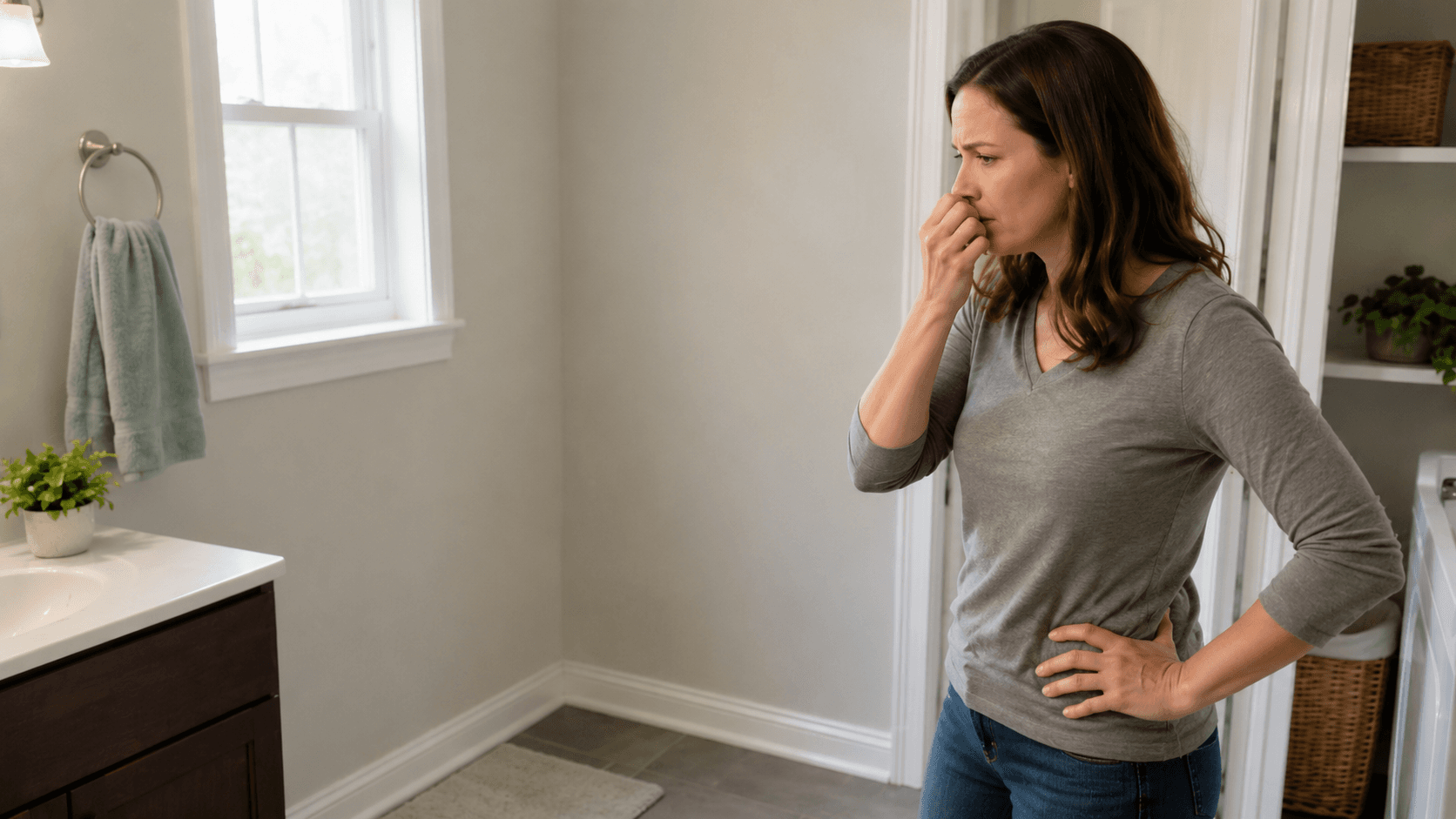
The short answer
Most household molds smell like a damp basement: earthy, musty, slightly sweet, with a hint of wet socks or old cardboard. The technical word is "musty," which doesn't really capture it. If you've ever opened a cooler that had wet towels left in it for a week, that's close. If you've been in a basement with persistent moisture, that's exactly it.
The smell is the result of MVOCs (microbial volatile organic compounds) released as mold breaks down its food source. These compounds are detectable by your nose at extremely low concentrations, often before the mold colony is visible. That's why "I can smell it but can't see it" is so common, and why it's a more serious signal than the reverse.
Why mold smells
Mold is alive. It eats. As it digests organic materials (drywall paper, wood, fabric, even dust), it produces metabolic waste in the form of gases. That's what MVOCs are. The specific cocktail of compounds varies by species, but many include geosmin (the same chemical that makes wet dirt smell like wet dirt), 2-methylisoborneol, and various alcohols and ketones.
Your nose evolved to be sensitive to these compounds because they signal decomposition, damp, and potentially contaminated food. In other words, your brain is hardwired to react to mold smell with a "something's wrong here" alert. Trust that instinct.
The strength of the smell roughly correlates with the size of the colony and how actively it's growing. A tiny patch in a shower corner might smell faintly. A large colony behind drywall can fill an entire room with a noticeable musty odor.
What mold actually smells like, in plain language
People describe mold smell in different ways. All of these point to the same thing:
- A damp basement (the most common description).
- Wet socks left in a gym bag.
- Old cardboard that got rained on.
- Wet leaves on a forest floor in autumn.
- An old, closed-up cabin opened after winter.
- A wet beach towel that didn't dry properly.
- The inside of a humid mushroom-growing tent (more pleasant version of the same idea).
What it doesn't smell like:
- Smoke or burning. That's usually a fire/electrical issue.
- Rotten eggs. That's sulfur, often a plumbing or sewer gas issue.
- Cat urine. Different organic compound; usually a pet issue.
- Gasoline or chemical solvents. Different category entirely.
If the smell is one of the latter, you have a different problem, not a mold problem.
Different molds smell slightly different
Most household molds share that core musty-earthy profile, but there are nuances:
- Black mold (often Stachybotrys) tends to smell strongly damp and "heavy." Many people describe it as the most pungent of household molds, with notes of wet cardboard or stale water.
- Aspergillus and Penicillium (the most common indoor molds) often smell milder, sometimes slightly sweet, like overripe fruit or stale bread.
- Mildew (the flat surface variety) usually smells faint or barely musty; if you smell it strongly, you're probably actually smelling mold, not mildew. See mildew vs mold.
- Cladosporium (common on textiles and wood) has a similar damp-earthy smell but sometimes a hint of green or vegetative quality.
You can't reliably identify the species by smell. But the strength and quality of the smell can tell you whether you have a serious colony or a minor issue.
Smelling mold you can't see
This is the situation that most often points to a real problem. If you can smell musty/earthy odor in a room but can't find the visible source, the colony is almost certainly hidden. Common hiding places:
- Behind drywall: usually after a slow leak from above (pipe, roof, window).
- Under flooring: flooring that got wet during installation or from a flood event years ago.
- Inside HVAC ducts, on AC coils, or in the air handler. The smell pumps through the whole house when the system runs.
- Under or behind cabinets: slow leaks at sink connections, dishwasher lines, refrigerator water supplies.
- Inside walls near roof penetrations: pipe chases, vent stacks, skylight flashing.
- Behind built-in furniture or shelving in basements.
- Inside ductwork insulation if it got wet.
The smell is the only way to detect these until the colony has grown enough to break through to a visible surface. By that point, you usually have a much bigger problem than if you'd investigated when the smell first appeared.
If the smell:
- Comes and goes with HVAC cycles → suspect the ductwork or air handler.
- Is stronger in one room or one corner → suspect a specific wall or floor cavity.
- Is worse on humid days → suspect a moisture-active colony that's blooming with humidity.
- Is worse after rain → suspect a roof leak, gutter overflow, or foundation seepage.
What to do if you smell mold but can't see it
Don't keep guessing. The standard sequence:
- Look in the obvious places. Under sinks, behind toilets, around tubs, in basements, in laundry areas. Move appliances if you can. Check for water staining, soft spots in drywall, or warped wood.
- Check HVAC. Pull a vent cover and shine a flashlight inside. If you see dark patches or smell mold more strongly at vents, the system is contaminated.
- Check humidity. Get a $15 humidity meter. The EPA recommends keeping indoor humidity below 60% (ideally 30–50%) and the CDC recommends no higher than 50%. Anything persistently over 60% supports mold growth somewhere.
- If you can't find it after these checks, hire a pro. A certified mold inspector with a moisture meter, infrared camera, and air-quality testing equipment can locate hidden colonies that visual inspection can't. See what is mold remediation for what an inspection involves, or request a free quote from MoldNation.
A note: the standard professional protocol involves visual inspection plus moisture readings plus (where relevant) tape-lift or air samples sent to an accredited lab. The CDC's broader position is that mold testing usually isn't necessary at all — if you can see or smell mold, you should remove it regardless of the test result.
What about the opposite, seeing mold but not smelling it?
Less common, but it happens. A few explanations:
- The colony is dormant. Mold that's not actively growing produces fewer MVOCs and may have minimal smell.
- The colony is small. A 4×4 inch patch of bathroom mildew won't fill a room with smell.
- You've adapted to the smell. Olfactory adaptation is real. If you've lived with the smell long enough, your brain stops registering it. Ask a friend who hasn't been in your home recently.
- It's not actually mold. Soot, water staining, or other dark marks can look like mold without the texture or smell that confirms it. See what does black mold look like for visual identification.
When to take the smell seriously
Treat a musty smell as a real signal, not just a nuisance, if any of these are true:
- It's persistent (not just after a recent shower or rain).
- It's in more than one room or follows your HVAC.
- It gets worse over time rather than fading.
- It returns after you've aired out the space.
- Anyone in the household is having unexplained respiratory symptoms that improve when they leave the home.
In any of these cases, the smell is likely from an active hidden colony that needs to be found and addressed, not just covered up with air fresheners or candles. Masking the smell doesn't fix the problem; it just delays the diagnosis.
Renting? Read this first
- Persistent musty smell in a rental is generally a landlord-level issue in most states, because it usually points to a structural moisture problem.
- Document the smell with written notes (date, location, intensity) and any associated symptoms. Email your landlord.
- Don't accept "it's just the basement" as an explanation for a persistent musty smell in living areas. That's often code for "we know there's mold but we don't want to deal with it."
- Check your state's tenant rights organization for habitability laws specific to your jurisdiction.
This article is general information, not legal advice.
Frequently asked questions
Does mold always smell?
Most actively growing mold does, but small or dormant colonies can have minimal smell. The absence of smell doesn't prove the absence of mold.
Why can I smell mold but not see it?
The colony is almost certainly hidden behind a wall, under flooring, or in HVAC. MVOCs travel through small openings and through HVAC systems. The smell can come from a colony many feet away from where you detect it most strongly.
Can the smell of mold make you sick?
The MVOCs themselves are not generally considered toxic at typical home exposure levels, but they're a marker of mold presence, and mold spores (not the MVOCs) can cause allergic and respiratory symptoms in sensitive people. If the smell is persistent and someone in the home has symptoms, the colony itself, not just the smell, is the concern.
What does black mold smell like specifically?
Strong, damp, "heavy" musty smell, often the most pungent of household molds. Notes of wet cardboard and stale water. See our black mold hub for more.
How can I get rid of the mold smell?
You can't, until you find and remove the source. Air fresheners, candles, and ozone generators temporarily mask the smell but don't address the colony. The smell returns. See how to get rid of mold for the actual solution.
Is "mold smell" the same as "old house smell"?
Sometimes. Many "old house" smells are exactly that: long-established moisture problems that have produced low-level mold colonies in walls, basements, or HVAC. A faint persistent musty smell in an older home is not normal and shouldn't be treated as cosmetic.
Will an air purifier remove mold smell?
A good HEPA + activated carbon air purifier can reduce the airborne MVOCs and spores temporarily, but it doesn't address the source. The smell will return as long as the colony is producing MVOCs. Use air purifiers for symptom relief while you locate and fix the source.
Related reading on MoldNation
- What does black mold look like?
- Mildew vs. mold: how to tell them apart
- Pink mold (it's usually not actually mold)
- Black mold: what it is, what it isn't, and what to actually do
- How to get rid of mold: the honest DIY guide
- What is mold remediation, and how do pros do it?
- Mold in the bathroom: what to do
Sources for this article: the EPA's "A Brief Guide to Mold, Moisture, and Your Home" (epa.gov/mold) and the CDC's mold page (cdc.gov/mold-health/about/) on indoor humidity recommendations; published peer-reviewed research on microbial volatile organic compounds (MVOCs) and geosmin; the ANSI/IICRC S520-2024 (4th edition) standard summary. This article is general information, not medical, legal, or remediation advice. If you suspect hidden mold causing health symptoms, consult a doctor and a certified mold inspector. Last updated May 28, 2026.