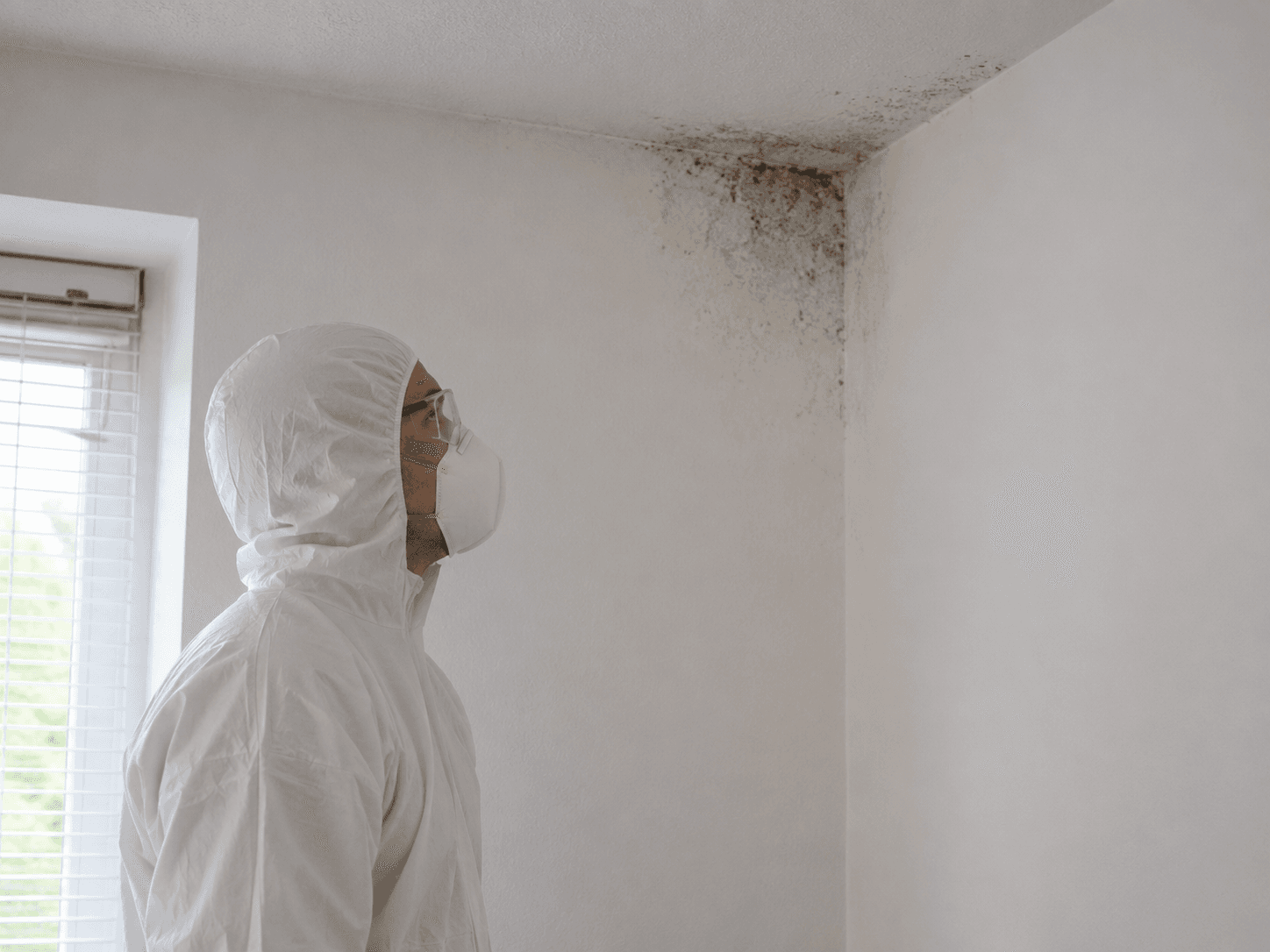
The short answer
Per 2025 industry data, most US residential mold remediation jobs land between $1,200 and $3,800, with the median around $2,300–$2,400 and per-square-foot rates of $12–$28 (most in the $15–$22 sweet spot). A bathroom with surface mold on tile and grout is usually on the low end — maybe a weekend afternoon for one technician, around $500–$1,500 all-in. A finished basement with mold on drywall and behind insulation can hit $6,000–$10,000 by the time materials are replaced. The places where the cost runs away from you are HVAC contamination (whole-system cleaning is its own line item), attic mold from a roof leak (you're often also paying a roofer), and any job that requires strict containment because someone in the house has asthma or there's an infant present.
Above the typical per-sq-ft range usually means complex containment, hazardous materials handling, or significant reconstruction. Below it usually means the pro is skipping steps you'd want them to take.
This article walks through the typical price ranges for each common scenario, what drives cost, and how to read a quote to spot what's missing.
What "mold remediation" actually covers
Before the numbers make sense, it helps to know what a real remediation job includes. The industry standard is the ANSI/IICRC S520-2024 (4th edition, published 2024), and a proper job follows these steps:
- Inspection and moisture mapping to find the extent of the colony, including hidden portions.
- Containment with plastic sheeting and negative air pressure (HEPA-filtered) to keep spores from migrating to clean areas.
- PPE for workers (N95 or P100 respirators, full coveralls).
- Removal of affected porous materials (drywall, insulation, carpet) and disposal in sealed bags.
- Cleaning and treatment of non-porous surfaces with EPA-registered antimicrobials.
- HEPA vacuuming of all surfaces in the containment area.
- Moisture source resolution — fixing the leak or moisture problem that allowed the mold in the first place.
- Clearance testing by an independent (third-party) lab to confirm spore counts are back to baseline before rebuilding.
- Reconstruction of removed materials — new drywall, paint, insulation. Sometimes this is bundled with remediation; sometimes it's separate.
When you see a $500 "mold removal" quote on a small job, parts of the above are being skipped. Sometimes that's appropriate (a 6-square-foot patch on bathroom tile genuinely doesn't need a containment chamber). Sometimes it isn't.
Typical price ranges by scenario
Numbers below are national averages from across the US — actual prices vary by region, with coastal cities and the Northeast typically higher than the South and Midwest. Always get multiple local quotes.
Bathroom surface mold (under 10 sq ft)
$500–$1,500. Tile, grout, around tubs, on shower walls. Usually one technician, half a day to a full day. Minimal containment required. No reconstruction in most cases. Often the line between "you can DIY this" (see how to get rid of mold) and "you want a pro" comes down to how much grout is involved and whether you have the time and tolerance to do it right.
Kitchen or laundry under-cabinet mold
$1,000–$3,000. Usually involves removing the cabinet base, cleaning the floor and lower walls, treating the framing, and (sometimes) replacing cabinet sections. Often triggered by a dishwasher or washing machine leak. Cost goes up if drywall replacement is needed.
Basement mold on drywall (single wall, no insulation)
$2,000–$5,000. Drywall removal, treatment of studs, dehumidification, clearance testing, drywall replacement. The reconstruction often runs as much as the remediation itself.
Basement mold with insulation involvement
$4,000–$10,000. Add the cost of insulation removal and replacement (insulation is irreparable once mold-contaminated). If the moisture source is foundation seepage, factor in waterproofing work to prevent recurrence.
Crawl-space mold
$3,000–$8,000. Variable based on access (some crawl spaces are nightmares to work in), moisture source (groundwater intrusion is expensive), and whether vapor barriers and encapsulation are part of the scope. A typical crawl-space remediation often includes new vapor barrier and dehumidifier installation.
Attic mold from roof leak
$2,500–$8,000 for the mold work, often plus $1,000–$10,000+ for the roof repair itself. The roof repair has to happen first or the mold returns. Some companies do both; others coordinate with a roofer.
HVAC contamination
$2,000–$6,000 for duct cleaning and treatment, on top of any source-room remediation. If the entire system has been distributing spores, the whole duct network needs cleaning. Insulation inside ducts that's contaminated may need replacement, which gets expensive.
Whole-house remediation (major flood, broad contamination)
$10,000–$30,000+. Multiple rooms, multiple material types, often coordinated with structural repair from the original water event. Insurance involvement is common (see does homeowners insurance cover mold).
"Black mold" jobs
Some industry sources report a 15–25% premium on jobs labeled "black mold," typically in the $12–$40 per square foot range. In reality, cost is driven by where the mold is, how much there is, and what needs to be removed, not the species name itself. Pros who quote a premium just for "black mold" are either flagging legitimate health-precaution containment or upcharging on the name. The CDC's position is that all molds should be treated the same with respect to potential health risks and removal. See black mold for what the species name actually means.
What drives the price
Five factors do most of the work in any quote:
1. Square footage of affected area. The most direct cost driver. Per-square-foot pricing in 2025 is roughly $12–$28 for typical work, with most jobs in the $15–$22 sweet spot. Complex containment or reconstruction can push to $25–$50+.
2. Type of materials involved. Hard surfaces (tile, sealed concrete, metal) are cheaper to remediate — they get cleaned, not removed. Porous materials (drywall, insulation, carpet, ceiling tiles, wood subfloor) get cut out and replaced, which adds removal labor, disposal fees, and reconstruction costs.
3. Moisture source. A remediation that doesn't fix the underlying moisture problem is a remediation that fails. If the source is something the remediation company can address (a slow plumbing leak, a known burst pipe), they may include it. If it's a separate trade (roofing, foundation waterproofing, HVAC), you're paying that contractor too.
4. Containment complexity. Simple jobs in unoccupied rooms have low containment costs. Jobs in occupied homes with vulnerable residents (asthma, allergies, infants, elderly) require more rigorous containment, negative air machines for longer periods, and often HEPA-filtered exit zones. That adds cost.
5. Clearance testing. Independent third-party clearance testing typically runs $200–$600 and is generally worth insisting on for any job over $3,000. It confirms the work succeeded and documents the result for insurance or resale purposes.
What you should see in a written quote
A real quote should itemize at minimum:
- Scope: which rooms, which materials, what's being removed vs. cleaned.
- Containment plan: how the work area will be isolated.
- PPE for workers (yes, you should care — workers without proper PPE are tracking spores all over your house).
- Removal and disposal of contaminated materials.
- Treatment products to be used.
- Moisture source resolution (or explicit note that it's not included and what trade is needed).
- Clearance testing — included or separate?
- Reconstruction — included or separate?
- Timeline.
- Total price with line items, plus what's not included.
If a quote is one line ("Mold remediation: $4,500") with no detail, ask for itemization. Don't sign anything that vague.
How to spot a low quote that's skipping steps
When you have three quotes and one is suspiciously low (say $1,500 against quotes of $4,500 and $5,200), the cheap one is usually missing one or more of:
- No containment. They'll clean the area without isolating it, which spreads spores throughout the house. Common in budget jobs.
- Surface cleaning without removal. They'll spray and wipe drywall that should be cut out. The mold comes back within months.
- No source resolution. They'll clean what's there without addressing the leak that caused it, knowing they'll be back.
- No clearance testing. No verification that the job worked. You only find out when the smell returns or symptoms persist.
- Workers without proper PPE. Lower labor cost, higher health risk and spore distribution.
- No reconstruction. "Removal only" with no plan for replacing the drywall they cut out. You're now hiring a separate contractor for the rebuild.
A cheap remediation that misses the moisture source is not cheap — it's a deposit on a more expensive future job. Vet on quality, not headline price.
How to spot a high quote that's overcharging
The opposite problem exists too. Signs a quote may be inflated:
- Charging "containment" for a small job that doesn't need it (a 4-square-foot patch on bathroom tile doesn't need a poly chamber).
- "Whole-house decontamination" sold as standard when only one room is affected.
- Required HVAC cleaning when there's no evidence of duct contamination.
- Premium "anti-microbial fogger" charges above and beyond standard treatment — most of these have limited evidence over standard wipe-and-vacuum protocols.
- Mold testing as part of the package when the homeowner can already see the mold (testing is for finding it, not confirming what's visible).
- "Toxic mold" surcharges based on species claims that haven't been lab-confirmed.
If a pro can't justify each line item in plain language when asked, that's the smell test.
DIY vs. pro: the cost calculation
For small surface mold under the EPA's 10-square-foot threshold on hard non-porous surfaces, DIY is genuinely fine. Cost: $20–$50 for cleaner (vinegar, bleach, or hydrogen peroxide), gloves, an N95, and an afternoon. See how to get rid of mold.
For anything above the threshold, on porous materials, near HVAC, or in a home with vulnerable residents, the DIY-vs-pro math usually favors the pro. The marginal cost of a $2,500 professional remediation that succeeds is dramatically lower than a series of $200 DIY attempts that don't and let the colony spread for six months.
The honest decision rule (also in black mold):
- Under 10 sq ft, on tile/glass/sealed counter/metal, healthy household → DIY.
- Above 10 sq ft, on drywall/wood/insulation/carpet, in HVAC, with vulnerable residents, or recurring after cleaning → pro.
How insurance affects the picture
Your homeowners insurance may cover some or all of the remediation if the underlying water damage event qualifies as a covered peril. Many policies have mold sub-limits that cap the mold-specific portion at $1,000–$10,000 even when the water damage event itself is covered. See does homeowners insurance cover mold for the full breakdown.
If insurance is involved, get the remediation pro and the insurance adjuster talking early — ideally before final scope is decided. Insurers sometimes have preferred vendor relationships or pricing standards that affect what they'll pay.
What about renters?
Tenants generally don't pay for structural mold remediation — that's the landlord's responsibility in most states for any mold beyond surface-level on tenant-controlled areas. If a landlord is pressuring you to pay for drywall-level remediation, push back in writing.
If your personal property was damaged by mold from a covered event, your renters insurance may cover the items (within policy limits). The remediation itself is usually outside renters insurance scope. See will renters insurance cover mold for a longer breakdown.
State habitability laws vary; contact a local tenants' rights organization for your jurisdiction. This article is general information, not legal advice.
Regional variation
Per 2025 industry data, prices peak in the Pacific Northwest and Gulf Coast where year-round humidity drives demand and labor costs run higher. Coastal cities and the Northeast generally run above the national average. The Midwest and Mountain West remain the most budget-friendly.
Other factors pushing prices higher:
- Markets with strict regulatory environments around mold (Florida, California, New York have more specific rules).
- Markets where remediation companies are unionized.
Three local quotes is the most reliable way to know what's normal in your area.
Getting quotes the smart way
The straightforward process:
- Identify the affected area as completely as possible. Photos, dimensions, what's underneath.
- Get at least three quotes from IICRC-certified pros.
- Make sure each quote is for the same scope. If one is for "remediation only" and one includes reconstruction, you're not comparing fairly.
- Ask each pro the same questions (see below) and compare answers, not just dollar amounts.
- Check certifications and reviews. IICRC certification, ACAC, state licensure where applicable. Recent reviews from independent platforms, not just the company's website.
- Don't pay full upfront. Standard is a deposit (25–50%) with the balance on completion. Be wary of pros demanding the full amount upfront.
If you want quotes from IICRC-certified pros on MoldNation, request a free quote. Most respond within an hour, and you can compare two or three before deciding.
Questions to ask each pro you're considering
- Are you IICRC-certified for mold remediation (specifically S520)?
- Will you provide a written, itemized scope of work?
- How will you contain the work area to prevent spore migration?
- Will you identify and address the moisture source as part of this job?
- Will you provide post-remediation clearance testing by an independent lab? If extra cost, how much?
- Is reconstruction included, separate, or coordinated with a partner contractor?
- What's your guarantee if mold returns in the same area within a year?
- What payment terms — deposit and balance, or full upfront?
- Can you provide references from local jobs in the past 6 months?
Pros who answer these confidently with specifics earn the work.
Frequently asked questions
What's the average cost of mold remediation?
Per 2025 industry data, most US residential jobs fall between $1,200 and $3,800. The median is around $2,300–$2,400. Small bathroom jobs come in lower; complex multi-room jobs come in much higher.
Does mold remediation cost include reconstruction?
Sometimes — depends on the company. Always ask. Some companies remediate only and hand off reconstruction to a partner contractor; others handle both. Itemized quotes tell you which.
How much does black mold removal cost specifically?
Some sources report a 15–25% premium on jobs labeled "black mold" (roughly $12–$40 per square foot), but most of that markup tracks scope and precaution level rather than species. The CDC says all molds should be treated the same for removal. See black mold removal cost for the longer breakdown once that article publishes.
Why are mold remediation quotes so different?
Mold pricing has more spread than most home services because scopes are interpreted differently, containment and clearance testing are optional in some pros' minds (they shouldn't be), and unscrupulous operators upcharge based on fear. Three quotes is the only reliable way to triangulate.
Will insurance pay for my mold remediation?
Sometimes — if the underlying water damage event is a covered peril and you're within any mold sub-limits in your policy. See does homeowners insurance cover mold for the full breakdown.
Is mold remediation tax deductible?
Generally no for personal residences. It may be deductible as a casualty loss in specific situations (federally declared disasters) or as a rental property expense. Consult a tax professional. This article is not tax advice.
How long does mold remediation take?
For small jobs, one day. Mid-size jobs (single-room drywall removal and replacement) usually 3–5 days. Major remediation (multi-room, HVAC, reconstruction) can run 2–4 weeks. The clearance test waiting period and reconstruction often take longer than the remediation itself.
Can I negotiate the price of mold remediation?
You can negotiate scope (skip the clearance test if you accept the risk, skip a non-essential antimicrobial fogger, do reconstruction yourself) and timing (off-season may bring discounts). Negotiating the per-square-foot rate directly is harder; pros work on fairly standard margins.
Related reading on MoldNation
- Does homeowners insurance cover mold?
- Mold test kits: what they actually tell you
- Mold detectors and air-quality monitors
- 10 warning signs of mold toxicity
- Black mold: the honest take
- What does black mold look like?
- What does mold smell like?
- How to get rid of mold: the honest DIY guide
- Mold remediation: the process explained
- Black mold removal cost
- Mold inspection cost
Sources for this article: ANSI/IICRC S520-2024 (4th edition) standard for professional mold remediation; the EPA's "A Brief Guide to Mold, Moisture, and Your Home" (epa.gov/mold) on the 10-square-foot DIY threshold and the EPA's "Mold Cleanup in Your Home" page on hiring professionals; aggregate 2025 cost data from HomeAdvisor, Angi, and other US remediation industry surveys (national average ~$2,300–$2,400 median, $12–$28/sq ft typical range). Prices reflect typical 2025 US ranges and vary significantly by region, scope, and contractor. This article is general information, not professional remediation or financial advice. Always get multiple quotes from certified local pros for your specific situation. Last updated May 28, 2026.