The short answer
The CDC's official position is that mold testing isn't necessary — if you see or smell mold, you should remove it regardless of species. That said, home mold test kits exist and people buy them. Most cost $10–$45 and fall into three categories: settle plate kits (you leave a petri dish open for an hour, mail it to a lab), tape lift kits (you press tape on a visible surface and mail it), or DIY air pumps that sample air for a few minutes. They'll usually tell you mold is present, because mold is present in basically every home, school, and office in the country. What they generally cannot tell you is: how much, of what species in a way that changes your cleanup, whether it's elevated compared to outdoor baseline, where exactly it's growing, or whether your particular health symptoms are related.
If you can see mold, you don't need a test to confirm it. Clean it up or hire someone to. If you smell mold but can't find it, a kit usually won't help you find it either — that's an inspector's job. If a doctor has asked you to document mold exposure for a health workup, ask the doctor what kind of testing they actually want (often it's a specific IgE blood test for mold allergy, not environmental sampling).
The kits aren't scams. They're just answering a different question than the one most people are actually asking.
What "testing for mold" actually means
Mold testing comes in two main flavors, with very different costs and reliability:
Surface or bulk sampling. A swab, tape lift, or piece of suspect material is collected and sent to a lab. The lab cultures it and identifies the species (or at least the genus). Useful for: confirming whether a specific visible spot is mold and which one. Not useful for: assessing overall indoor air quality.
Air sampling. Air is pumped through a collection cassette for a set time, and the spores trapped on the cassette are counted under a microscope. Useful for: comparing indoor to outdoor spore levels, detecting hidden colonies that don't have visible growth, post-remediation clearance. Not reliably useful for: a single passive "settle plate" with no outdoor comparison.
Most cheap home kits are either surface-only or are passive air collection without a meaningful comparison. The "real" version of either test — done by a certified inspector with calibrated equipment and outdoor controls — costs more but gives you something interpretable.
Why most DIY kits give you positive results
Mold spores are a normal component of indoor and outdoor air. The CDC's mold guidance is blunt about this: it is not possible or desirable to eliminate all mold spores from an indoor environment. Outdoor air typically carries hundreds to thousands of spores per cubic meter. Indoor air picks up most of that through doors, windows, and shoes. A petri dish left open in an average kitchen for an hour will almost always grow something.
So when a passive settle-plate kit comes back saying "mold detected: Cladosporium, Aspergillus, Penicillium" — those are three of the most common indoor and outdoor molds in the country, found in virtually every building. That result by itself does not mean you have a "mold problem." It means you have air.
This is also why catastrophic-sounding reports from cheap kits should be read carefully. A list of detected species without a control sample, a calibrated count, and an outdoor comparison isn't the kind of data a remediation pro or doctor can use for decisions.
The kit types, ranked by usefulness
These are the categories you'll find on the shelf at Home Depot, on Amazon, or via mail-in lab services. Ranked roughly by how useful they actually are.
Tape lift / swab kits ($10–$30)
Most useful of the consumer options, in a specific situation. You press an adhesive tape strip against visible mold (or swab the surface), mail it to a lab, and they identify the species under microscope.
Genuinely useful when: you have a clearly visible mold spot and you specifically want to know the species (for medical reasons, legal documentation, or to confirm "is this what I think it is"). Lab analysis is generally reasonable for confirming what the visible growth is.
Not useful for: finding mold you can't see. The test only tells you what's on the swab.
Settle plate kits ($10–$25)
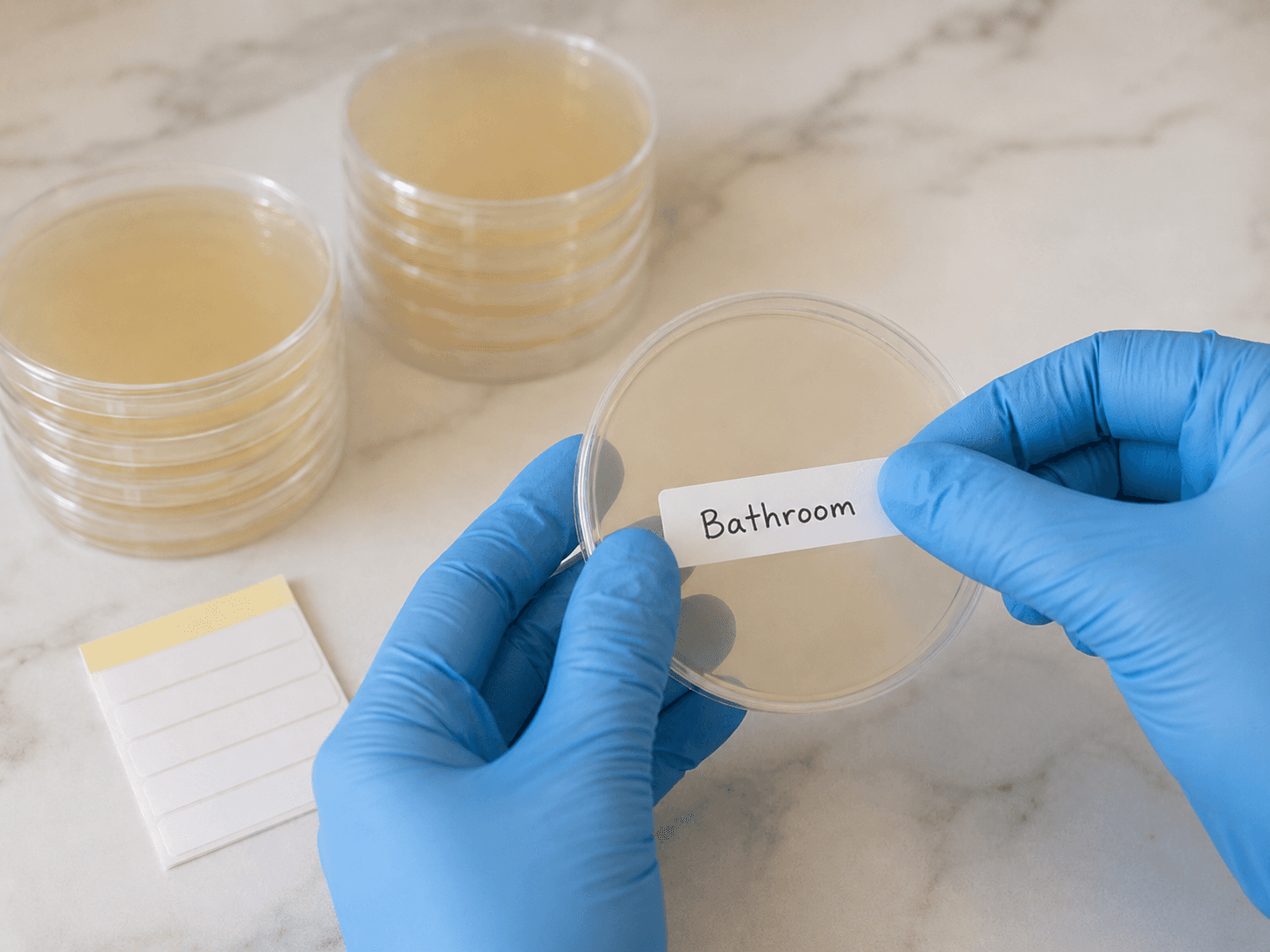
A small petri dish with growth medium that you leave open in a room for an hour, close, and either mail to a lab or incubate yourself for a few days.
Mostly not useful. Settle plates without an outdoor comparison are not considered a reliable assessment tool in industry standards. The American Industrial Hygiene Association and most certified mold inspectors don't use settle plates for diagnostic decisions because the counts aren't quantitatively meaningful.
The one case where they have some value: as a relative comparison if you run the same plate type in multiple rooms at the same time of day, looking for one room with dramatically more growth than the others. Even then, an inspector would do this with calibrated air sampling instead.
Mail-in air sample kits ($30–$60)
These come with a small pump that runs for a few minutes, drawing air through a cassette that you mail to a lab.
Better than settle plates because they actively pull a measured volume of air through the cassette. Still much less useful than a professional inspector's air sample because:
- Most kits don't include an outdoor control sample for comparison.
- Sample duration is often too short for accurate counts.
- You're not trained to choose representative sampling locations.
- Lab interpretation without context can't really tell you whether the numbers are elevated.
Where they make sense: you want a rough indoor vs. outdoor comparison and the kit comes with both indoor and outdoor cassettes. Read the kit description carefully before buying.
DIY mold sensors and air-quality monitors ($60–$300)
These are a different category — continuous indoor air-quality monitors that often track humidity, particulate matter, VOCs, and sometimes specifically "mold risk." Useful for monitoring conditions; not actually identifying mold species. We cover these in detail in mold detector.
When a test kit is genuinely worth buying
There are real cases where a kit answers your question well enough:
- You have visible mold and want species identification — a tape lift kit is reasonable. About $15–$30. The lab will tell you what genus you've got.
- You want a before/after baseline around remediation work — useful for proving the work was effective, though a pro-collected clearance test is more defensible if you're in a dispute with a remediation company.
- You're documenting environmental exposure for a doctor's workup — but ask the doctor first what kind of testing they actually want. Many clinicians prefer specific IgE blood tests for mold allergy over environmental sampling.
- You're a buyer doing pre-purchase due diligence and just want a quick screen — a $30 kit is better than nothing, but a real pre-purchase mold inspection by a certified inspector is dramatically more thorough.
In all of these, the kit isn't substituting for an inspector. It's answering a narrow question.
When a test kit is a waste of money
These are the situations where most people are buying the test, and where the answer it gives you usually isn't what they need:
- "I want to know if my house is safe." A kit can't tell you that. Even a perfect inspection can't really tell you that in a single number. "Safe" depends on who lives there and what they're sensitive to.
- "I smell mold but I can't find it." The kit will tell you spores are present. It won't tell you where. An inspector with a moisture meter and (sometimes) thermal imaging is far more useful. See what does mold smell like.
- "I want to confirm what species the spot in my bathroom is." Cleanup decisions for indoor mold rarely depend on species. The protocol (clean a small patch on a hard surface, call a pro for anything bigger) is the same regardless. Knowing it's Cladosporium vs. Aspergillus doesn't change what you do.
- "My family is sick and I want to prove it's the mold." This is a doctor's question, not a mold tester's. See your doctor; mention the environmental concern; let the workup proceed.
Settle plates and the "incubate it yourself" trap
A common pattern in cheap kits: a petri dish, instructions to leave it open for an hour, then incubate it in a warm dark spot for 48–72 hours. Whatever grows, you photograph and (optionally) send to a lab.
This is the least informative version of mold testing for a few reasons:
- Everything will grow something. The plates are designed to be permissive to mold growth.
- The visual "amount" doesn't translate to a meaningful number. Three colonies vs. fifteen colonies depends as much on how long you left it open, where in the room, what the temperature was, and how warm the incubation was as on actual mold concentrations.
- Species identification by visual inspection of a colony is unreliable. Even mycologists usually use microscopy.
- There's no comparison. Without a simultaneous outdoor sample using identical conditions, the count is uninterpretable.
If the kit is mostly "leave plate, incubate, send picture to lab" and costs under $20, set your expectations accordingly. It's a conversation starter, not a diagnosis.
What professional mold testing actually involves
For comparison, here's what a certified mold inspector does that a $25 kit doesn't:
- Visual inspection of the property, including non-obvious areas (HVAC closets, attic spaces, behind accessible appliances).
- Moisture meter and (often) thermal imaging to find wet or recently wet materials, including hidden ones inside walls.
- Multiple calibrated air samples taken at standardized flow rates over enough time to get a meaningful count. Includes an outdoor control sample taken the same day for comparison.
- Surface samples from suspect areas for species ID (when relevant).
- A written report with lab-analyzed spore counts, indoor vs. outdoor comparisons, and recommendations.
Cost: most US residential mold inspections in 2025 fall in the $300–$1,000 range, with the national average around $670 per industry data. Smaller homes (under 4,000 sq ft) typically run $300–$400; larger or more complex inspections can hit $700–$1,100+. Look for inspectors certified by ACAC (CIEC, CMI), IICRC, or comparable bodies. See mold inspection cost for more on what drives the price.
Remember: the CDC's position is that testing usually isn't needed at all. The cases where it genuinely adds value are narrow (real-estate due diligence, post-remediation verification, dispute documentation). Don't pay $700 to confirm what you can already see with your eyes.
The decision rule
Here's the plain decision flow:
- Can you see mold? Don't test. Clean small patches on hard surfaces yourself (see how to get rid of mold) or call a pro for anything bigger.
- Can you smell mold but not find it? Don't buy a kit. Hire an inspector or a remediation pro with diagnostic equipment.
- Do you need species ID of visible growth for medical or legal reasons? A $15–$30 tape lift kit is reasonable.
- Are you trying to document conditions before or after remediation? Pro testing is more defensible, but a kit can be a budget-friendly supplement.
- Anything else — likely either no testing is needed (small visible mold is self-explanatory) or pro testing is needed (hidden suspected mold).
The kit shines in narrow cases. For most "should I be worried" questions, the kit is the wrong tool.
What to do once you have results (DIY or pro)
If the test or inspection finds significant mold or elevated indoor spore counts, the response depends on size and surface:
- Small surface mold on hard, non-porous materials: DIY cleanup is appropriate. See how to get rid of mold.
- Anything larger than 10 square feet (EPA threshold), on drywall, wood, insulation, ceiling tiles, or near HVAC: professional remediation. See mold remediation cost for what to expect to pay.
- Recurring mold that comes back after cleaning: there's an unaddressed moisture source. Find and fix it before more cleaning.
For homeowners, does homeowners insurance cover mold covers what your policy might pay for.
If you want quotes from IICRC-certified pros on MoldNation, request a free quote. Most respond within an hour, and you can compare two or three before deciding.
Renting? A quick note
If you're a tenant trying to use a test kit to document a mold problem for your landlord:
- A DIY kit's results are usually weak evidence in any landlord-tenant dispute. A certified inspector's report is far more defensible.
- Photos of visible mold and dated written communications matter more than a positive test kit result. Document what you can see, when you saw it, and when you notified your landlord.
- State habitability laws vary. Many states require landlords to address mold caused by structural moisture issues; specifics differ. Contact a local tenants' rights organization for your jurisdiction.
This article is general information, not legal advice.
Questions to ask if you're hiring a mold inspector
- Are you certified by IICRC, ACAC, or a comparable body?
- Will you take air samples with an outdoor control taken the same day?
- Do you use a moisture meter and (where appropriate) thermal imaging?
- Are you affiliated with a remediation company, or are you independent? (Independent inspectors avoid the conflict of interest in finding work for themselves.)
- Will I get a written report with lab-analyzed results?
- What's included in your quoted price, and what costs extra?
An independent inspector is generally preferable to one tied to a remediation company, because they aren't motivated to find a job for themselves.
Frequently asked questions
Are home mold test kits accurate?
They reliably detect that mold spores are present — which is almost always true in any indoor environment. They are less reliable at telling you whether spore levels are elevated, what species are problematic, or where mold is growing. The "accuracy" question depends entirely on what question you're asking.
How much does a professional mold inspection cost?
Most US residential mold inspections in 2025 fall in the $300–$1,000 range, with the national average around $670. Smaller homes (under 4,000 sq ft) typically run $300–$400; larger or more complex jobs hit $700–$1,100+. See mold inspection cost for more detail.
Can a doctor order a mold test?
A doctor can order mold allergy testing for you (specific IgE blood tests or skin prick tests for common mold allergens). They generally don't order environmental mold testing of your home; that's between you and an inspector.
What's the difference between a mold test and a mold inspection?
A "test" usually means a single sample (surface or air) analyzed in a lab. An "inspection" is a broader evaluation that includes visual assessment, moisture measurements, and usually multiple samples with proper controls. Inspections are more informative; tests are cheaper.
Should I test for mold before buying a house?
For older homes or homes with any history of water damage, yes — but get a proper pre-purchase mold inspection, not a $25 kit. The findings can be a negotiating point with the seller and protect you from a five-figure surprise later. Some general home inspectors will spot obvious mold but don't typically test air quality.
What about ERMI testing?
ERMI (Environmental Relative Moldiness Index) is a more specialized test that uses DNA analysis of dust samples. Some practitioners (especially in environmental and functional medicine) rely on it heavily. Mainstream industrial hygiene and the EPA do not currently endorse ERMI as a primary diagnostic tool for indoor mold assessment, though research on it continues. If a clinician recommends it, ask them to explain what they'll do with the results.
Can I just buy a moisture meter instead?
A $20–$40 moisture meter is one of the most useful tools a homeowner can buy. It can tell you whether materials (walls, floors, behind cabinets) are wet — and wet materials are the precondition for mold. Many problems are found faster with a moisture meter than with any spore test. We cover this and continuous air-quality monitors in mold detector.
Related reading on MoldNation
- Mold detectors and air-quality monitors
- 10 warning signs of mold toxicity
- How much does mold remediation cost?
- Does homeowners insurance cover mold?
- Black mold: the honest take
- What does black mold look like?
- What does mold smell like?
- How to get rid of mold: the honest DIY guide
- Mold inspection cost
- How to test for mold in your house
Sources for this article: the CDC's published mold guidance, including its position that "CDC does not recommend mold testing" (cdc.gov/mold-health/about/); the EPA's "A Brief Guide to Mold, Moisture, and Your Home" (epa.gov/mold); the ANSI/IICRC S520-2024 standard for mold remediation (including the relevance of clearance testing); and 2025 US mold inspection cost data from industry surveys (Angi, HomeAdvisor, Bob Vila). This article is general information, not professional inspection or remediation advice. Last updated May 28, 2026.